
What is Anabolic Resistance
And Why You Should Care


I’ve been obsessed with protein for years– and it turns out that now the rest of the world is too. I draw the line at buying ‘high protein’ labels in the grocery; it reminds me of the ‘low cholesterol’ days of the 1990s when everything (including foods that, being derived from plants could not possibly contain the stuff) were labeled ‘low cholesterol’. There is plenty of protein in foods from many sources, as all creatures, whether animal, plant, or otherwise, rely on proteins for vital structural and functional components. That said, not all protein is created equal. Differences between plant and animal sources, for example, fall under the rubric of protein quality, which I wrote about in previous posts on the importance of muscle tissue.
There are a couple problems with getting enough protein – and this amount (you’ll see it as grams/kg or per pound) has been evolving in the past decade as well – as we age. One important issue is called anabolic resistance. Time for a deep dive.
Technically, anabolic resistance just means the body becomes less responsive to anabolic stimuli. What does this mean? To understand this, I have to introduce the notion of metabolism: All of the countless chemical processes taking place continuously in the body that support normal function and life itself. Here is an abbreviated example of just a few of these pathways (don’t try to read it, just appreciate the sheer volume and complexity):
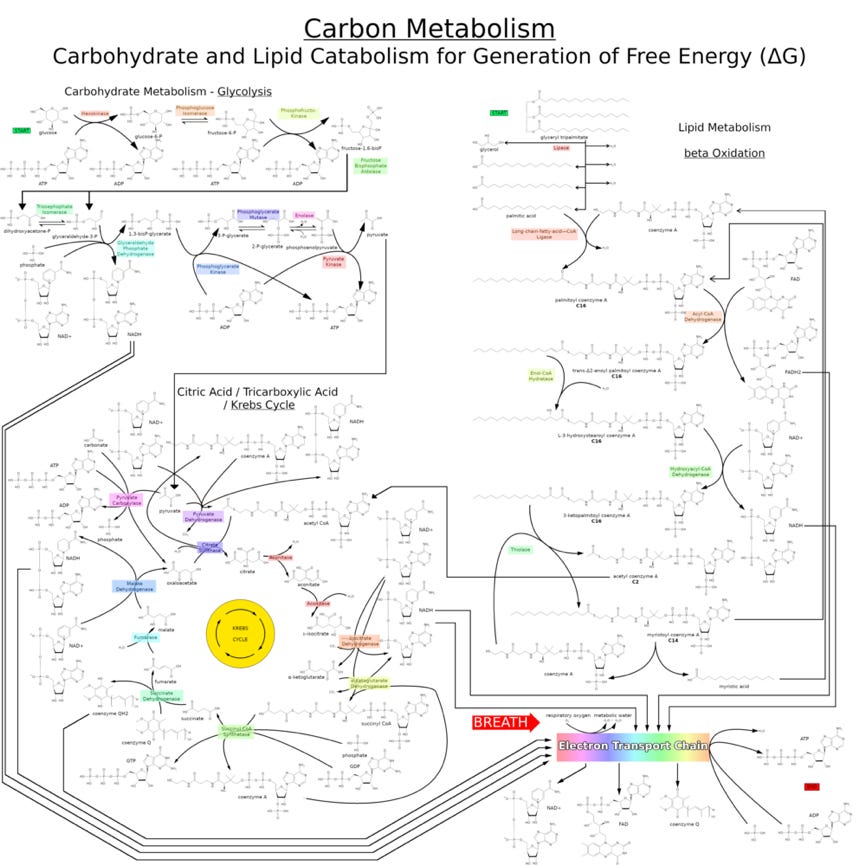
There are two sides to this beast. People mainly think of catabolism when discussing metabolic pathways: what happens to food when it is broken down to release energy (some of which you can see in the diagram above).
Anabolism, the opposite of catabolism, is the process of building UP body components e.g. muscle, bone, organs, etc. Think of anabolic steroids - well known drugs for building big muscles in body builders. In this post, I’ll focus on anabolic resistance. The definition is simple: anything that reduces, or resists, the building (anabolic) process. In the context of protein intake, this leads to reduced ‘muscle protein synthesis’ (MPS, or the process of building muscle).
For a brief refresher on the structure of proteins and their formation from amino acids:
In a nutshell, anabolic resistance is important because we want to maintain the muscle we have as we age. In order to do that, we have to continually ‘remodel’ the muscle tissue. Amazingly, all of the muscle you have is re-built every few months. Imagine having a construction crew at your house, constantly taking walls, floors, fixtures, etc. apart and rebuilding everything to keep it running as smoothly as possible. This is what our bodies do in the ongoing process of keeping entropy at bay.
Of course, the body can recycle many of the amino acid building blocks of protein from the tissue that is dismantled. But inevitably, a small percentage is lost, or needs replacement, due to damage. And of course, if you are building new muscle (MPS), you will need more of these building blocks, which you get from eating protein.
Anabolic resistance in this picture can take two forms. First, as we get older, all of our systems become less efficient, including our digestive systems, which dismantle the protein we eat into individual amino acids (less often into short chains of 2-3 aminos). For the same amount of protein you ate as a 20 something, as a 60+something, you may only be pulling out 80-90% of the same amino acids. Clearly, this gives you fewer building blocks and the result is less muscle protein synthesis. The fix is easy, up your dietary protein intake.
If you are interested in a deeper dive into the process of muscle turnover and remodeling, read on. This occurs in several stages:
First, the muscle stem cells, called satellite cells, are stimulated to turn on and divide (which of course uses amino acids to build the proteins of the new cells), and we get a bunch of unspecialized (i.e. early stage in development) muscle cells, called myoblasts.
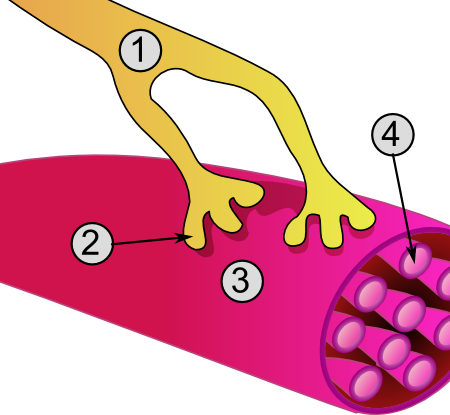
These ‘baby’ myocytes (the jargon term for a mature muscle cell) continue to differentiate (i.e. mature into the specialized shape, structure and function of active muscle). At this point, they do what muscle cells do as they develop into the large, contractile forms familiar to us – they fuse together to form either new muscle fibers or they fuse with damaged fibers to repair them. These fibers are what we typically think of as muscle cells – long, thready structures (which you have probably gotten in your teeth if you eat steak), hanging on to the cell nuclei from the many myoblasts that fused to form each myocyte. The new fibers grow in width as they synthesize and incorporate new actin and myosin – yet more proteins, these do the contracting in muscle. You can see those fibers under the #4 arrow in the cartoon (1 is the motor nerve, 2 is the synapse or connection between nerve and muscle, and 3 is the myofiber or entire muscle cell).
(A brief aside: the main job of skeletal muscle is to contract, usually pulling on a bone. Said contraction moves the bone in one direction. Contract your biceps (actually a group of several muscles), and your lower arm moves inward. To reverse this motion, you contract your triceps, (same thing- a group of muscles again acting in concert) which pulls the lower arm in the opposite direction. To get really geeky, this muscle pair is called agonist and antagonist, and all joints have at least one such pair. There are other types of muscle in the body, but these (smooth and cardiac) are not typically under voluntary control.)
Meanwhile some of the satellite cells from step one above, take a 180 degree turn, returning to their usual dormant state so as to maintain a stem cell pool for the future.
Finally, collagen (the most abundant protein in the body; think more amino acids needed) is laid down around the new fibers to provide a supportive scaffold. Blood vessels and nerves are extended into the new tissue, which is now ready to go.
But, if you didn’t have enough amino acids from the recycling process and your diet, the rebuilding is limited or never starts. Now we’re back to anabolic resistance. I introduced the first form earlier, as reduced uptake from the digestion of dietary protein. The fix: increase the amount of protein in your diet. This recommendation is becoming increasingly common in both research on healthy aging and the social media landscape. I won’t weigh in on this controversial topic because it would take pages and pages to discuss the pros and cons of each recommended dose, but both Rhonda Patrick and Peter Attia have good podcasts on the subject.
The second, less well-discussed aspect of anabolic resistance is that occurring at the muscle end of the path. You have to get the amino acids out of the food (step 1 above) then through the blood to the delivery site in the muscle. (The liver, which is the first stop for blood leaving the intestine, takes a lot of the amino acids as it is continually – and importantly- building a variety of essential enzymes; but we won’t worry about that here.)
You may know that all cells have an external membrane that is very choosy in terms of what gets in and out – the intracellular environment is a selective, gated community. The only way in for big molecules like amino acids is through ‘gates’ called transport proteins. There are different transporters for specific types of amino acids (e.g., large neutral, small neutral, or amino acids with electrical charge).
And here’s the thing about the transporters that relates to anabolic resistance. They are REALLY sensitive to a variety of signals that tell them the cell does or does not need specific amino acids. For example, resistance exercise (aka weight training) causes muscle growth because it leads to small tears in muscle fibers. You saw earlier how damage to the muscle cell activates repair mechanisms which then require amino acids coming into the cell for rebuilding.
The inflammatory signal from that tissue damage not only tells the transporters already in the cell membrane to open up to the amino acids but also turns on expression of the genes for the transport proteins so as to increase uptake from the blood. What’s more: once these transporters move their amino acids inside the cell, that further stimulates the whole anabolic process of remodeling muscle. So, resistance training not only opens the doors for immediate repair, it also sets the stage for longer term muscle maintenance.
It’s the flip side of this entry/activation process that results in anabolic resistance at the muscle. Many people suffer from insulin resistance, a chronic condition typically caused by a combination of poor diet (especially one high in processed carbs) and lifestyle (little or no exercise). The result is chronically high blood sugar, which normally causes a transient insulin signal. When insulin binds to glucose transporters in cell membranes, these bring glucose into the cell. When blood glucose is chronically elevated, muscle (and other) cells are full, the transporters are not available, insulin can’t bind, and glucose keeps circulating, eventually ending up in fat cells. (It’s a long complex story that we won’t get into further but if you want to pursue it, both of the earlier mentioned podcasts have good episodes on metabolic disease and/or insulin resistance.)
To bring this back to anabolic resistance, when insulin binds to the glucose transporter, not only does glucose enter the cell, but a signal is generated that inhibits protein breakdown. This signal alone reduces anabolic resistance because the breakdown pathway is turned down. But there’s more. The insulin signal also stimulates the amino acid transporters so the pool of amino acids in the muscle increases, ready to rebuild when needed.
To sum it all up: anabolic resistance is any process in the body that reduces our ability to build or repair muscle. Its’ a bigger problem as we age for two reasons. First, the gut becomes less efficient at extracting amino acids from the protein we eat. This has a relatively easy fix: eat more protein, especially easily digested and utilized protein.
Second, in many of us, the access points for amino acids into the muscle cells are compromised; often because of insulin resistance, but also because of a more sedentary lifestyle. The fix is easy to say but harder to do: reduce processed carbs (i.e. lower blood sugar) and exercise.
Finally, I can’t overstress the importance of resistance (aka weight) training. Not only does it build bigger stronger muscles – which are one of, if not THE main predictor of healthy aging – but also streamlines the process by which those muscles get built and maintained. Two for the price of one!
Thanks, Beth. That's very informative. One important questions: What are examples of "easily digested and utilized proteins"?