
How to Read a Scientific Paper
You may want to try!

How to read a scientific paper
Most of my references come from ‘peer-reviewed’ papers published in reputable scientific journals. Peer-review means that when a paper is submitted to a journal for publication, several independent and hopefully unbiased scientists with credibility in that area, will review it. Only when the reviewers approve, or the author(s) can refute the criticisms (typically by doing additional work), is the paper accepted for publication. Of course, there are glitches in the process, but by and large, it ensures the publication of solid science. This process, considered essential in modern science, usually ensures that only high quality, verifiable scientific studies are published.
Back in the day when I wrote a paper, I had to decide on a journal I wanted to submit to, and send it off to an editor. Most journals are highly specialized in their content and have multiple editors, typically each a specialist in a sub-discipline of the journal. The editor would then contact several researchers in my field, qualified to read and evaluate my methods, results and analysis, and ask them to do so.
As science has grown, the number of papers (i.e. publications) has also grown. It has gotten more and more difficult to convince would-be reviewers (who are usually academic scientists, with multiple commitments in research, teaching and university service, not to mention clinical hours for medical researchers) to take on the review process. The result: longer review time, meaning bigger delay between completing research and its publication. Another problem is sloppier reviews, meaning that some less than stellar research is published. And recently, some for-profit journals have popped up which will publish a paper without reviews, for a price.
All of these issues have produced some changes in the way research is made available for mass consumption. First came the online journals that had no print editions. The earliest were the public library of science family (PLOS) that made online content freely available, a big change from the print editions that were really expensive.
Then came preprint publications. These are manuscripts posted on a public server prior to formal peer review. As soon as it's posted, it becomes a permanent part of the scientific record, citable with its own unique record.
OK, that’s all by way of background. Now, let’s say you want to actually read one of these things. Finding the right one can be tricky. How do you know if you’re getting one from a good journal, or a preprint?
If you are doing a google search for specific topic, of course all kinds of references will come up. Some of these can be highly informative, and others garbage. I suggest sticking to Pubmed, the database maintained by the National Institutes for Health, the US government agency which funds the lion’s share of biomedical research in the country.
A search here will likely come up with dozens (or more, depending on how specific your search terms are) of papers. And, Pubmed will tell you if the citation is a preprint or a published (i.e. peer-reviewed) paper. You can sort the search results in chronological order, by their availability (abstract only, free or paywall), and by type: book, book chapter (these may or may not be peer-reviewed), journal article (almost always peer-reviewed), and even clinical trials.
Once you find an article, you can click on the link to access it. The first thing you see is the abstract – sometimes the only part of the paper you can access through Pubmed. An abstract is just a summary of the paper’s finding. Sometimes the journal lays it out in the same format as the paper itself: introduction, methods, results, discussion. More typically it’s a paragraph or two summarizing the findings, with perhaps an inkling of the research methods and their significance.
Although many people say the first thing to look at in a scientific paper is the results, I disagree. If I’m reading in a field I am really familiar with (not that many in today’s world), sure I can jump to results because I know the background of the study, the methods, and the potential significance of the results.
If the paper is in an area I’m less familiar with, starting with the abstract allows me to decide if I want to read the paper. In fact, the highly detailed titles of many papers often give you a leg up here! The abstract will summarize the highlights of the research, a hint of the methods, and the take-home message (i.e. the importance of the results).
Now you’ve read the abstract and decided you want to get at the information in this paper. Don’t jump to results quite yet. Reading the introduction will give you some background on the problem the researchers are focusing on which may be helpful to put the study in context. I always read the methods section, sometimes after reading the results, because I want to evaluate just how the question of the study was answered. Sometimes this necessitates a separate search, often in Wkipedia, if I’m not familiar with the methodology.
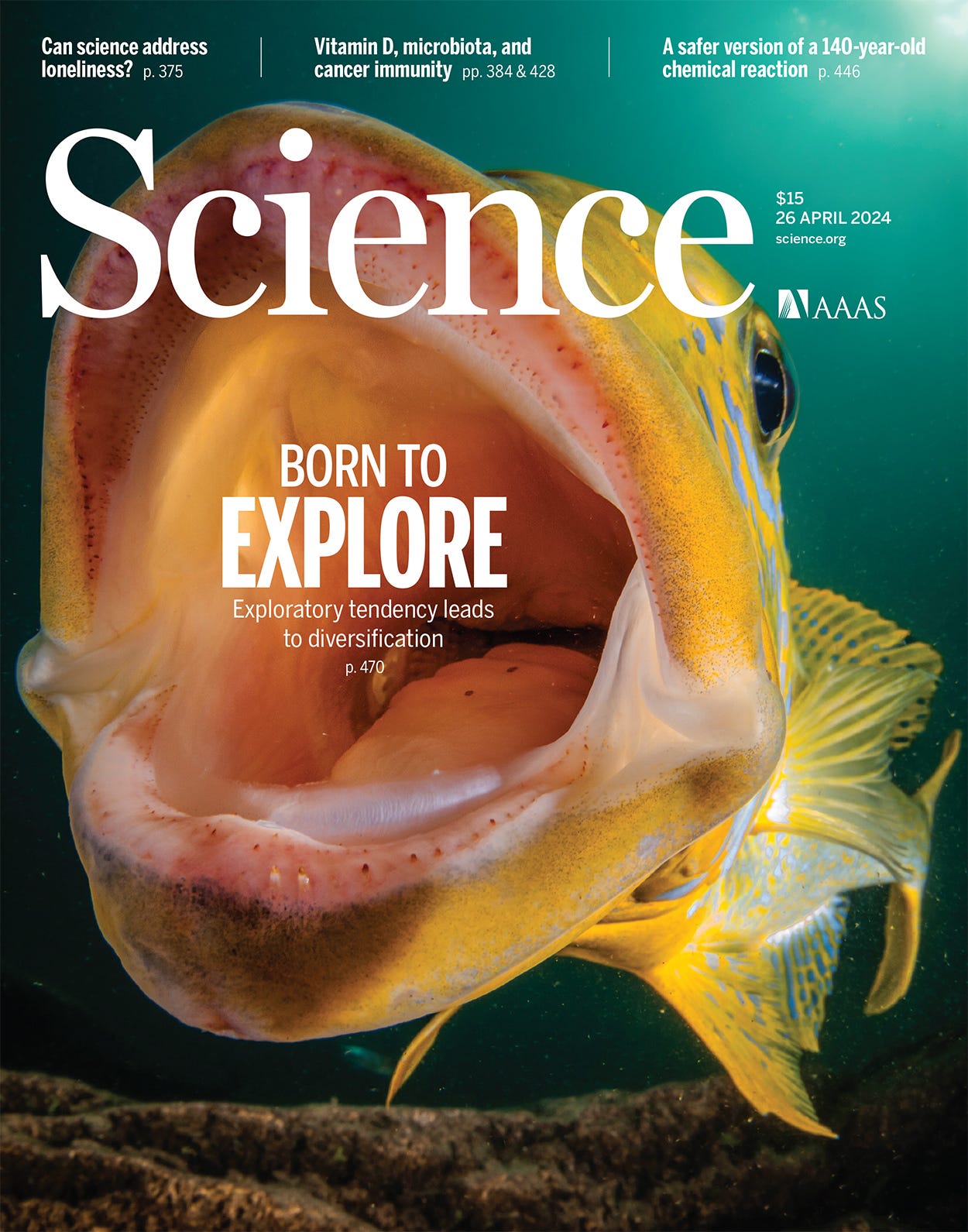
Before you give up on the whole idea, thinking it’s too overwhelming, keep in mind that for many topics of biomedical interest, a research paper will be focused on a single question or several related topics that are addressed by a few experiments. Papers in the big 3 journals of biomedical science, Science, Nature and Cell, tend to cover bigger questions and because of the number of papers per issue, the methods and introductions tend to be condensed and heavy on jargon.
Now, if you’ve gotten through the results and want help interpreting them, read the discussion. This section can be useful but keep in mind that the authors will focus on how the results support their ideas. Sometimes alternative explanations, or problems with the data or conclusions are presented, but in general this section wants to convince you that their results support their explanation of the phenomenon they’re investigating.
That’s enough on how to read one, next time, we’ll look at an actual paper - one that has some real problems but has had a big impact.
Thanks, Beth! Good summary. It might be interesting to see how the peer review process occasionally goes awry. Where does the problem of (lack of) reproducibility of results stand? For a while, it seemed like a serious problem, particularly in biomedical research. Maybe that has changed.